
On Monday 27 July 2026, the Malta Tourism Authority resumes accepting new short-let licence applications — for the first time under the new Tourism Accommodation Regulations. If you've had a half-ready file sitting on your desk since the 15 June freeze, you're not the only one — the whole island has been in a holding pattern. Here is exactly what to have ready this week to be in the first wave, why the first wave is worth it, and the traps that quietly kill applications.
The short version
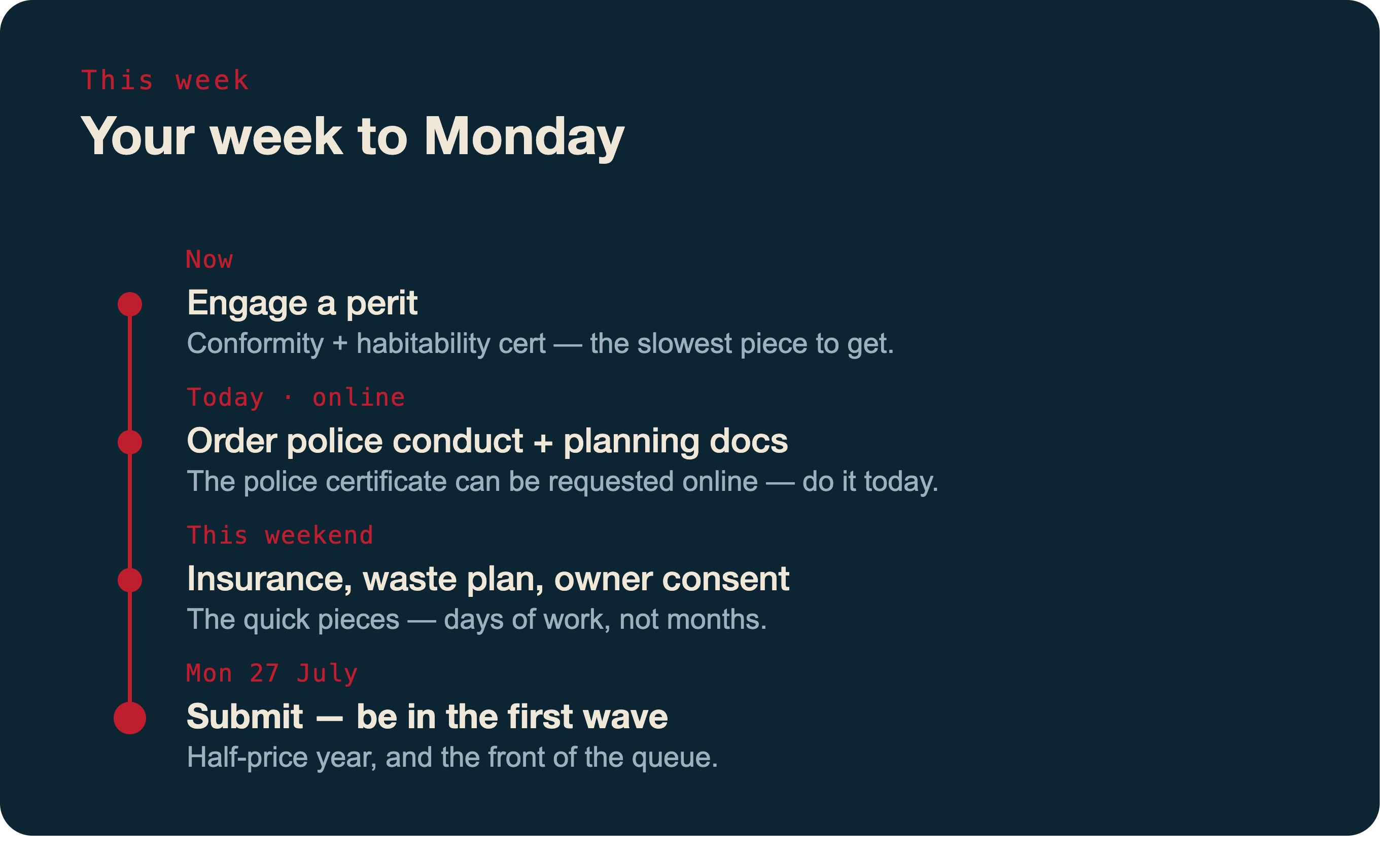
- Applications reopen Monday 27 July. The queue will only grow — prepare the file this week.
- Half-price advantage: licences issued after 1 July pay 50% of the annual fee and contribution for the year.
- The slowest pieces are the perit certification and planning documents — start those first.
- Two silent killers: ignoring an MTA request for 90 days (application deemed withdrawn, no refund) and unreadable or inconsistent drawings (bounced without review).
- Don't operate while unlicensed: the 3-year disqualification attaches to you AND the property address.
Why the first wave is worth the scramble
Three reasons to aim for the opening days rather than "sometime in August". Money: under the fee regulations, a licence issued after 1 July pays half the annual licence fee and contribution for that year — for a typical Malta apartment, roughly €93 instead of €186 (run your exact figure in our fee calculator). See the full cost breakdown for how the fees stack up. The queue: the MTA must decide within 60 days of validating a complete file — but validation itself takes as long as the pile in front of you is high, and every operator who waited since June is about to join it. Risk: every week of unlicensed operation is a week of exposure to the regime's headline penalty — a 3-year disqualification covering both the operator and the property address, surviving even a sale. With platform data-sharing to authorities progressively activating under EU Regulation 2024/1028, "quietly listed while waiting" is a shrinking hiding place.
The document checklist — gather these now
Your application file
- Identity documents — ID card (both sides) for the applicant, the designated 24/7 contact person, and the operator if different. Companies: M&A plus a board resolution.
- Police conduct certificate — recent, for applicant and operator. Obtainable from the Malta Police Force, including online — order it today if you don't have one.
- Planning permission + approved drawings — with your unit outlined in red. Pre-1968 properties: compliance certificate or an architect's declaration instead.
- Perit (architect) certification — conformity with planning permission and fitness for habitation. This is the piece that sets your whole timeline. Perits get booked solid the moment a deadline like this lands — a phone call today beats a scramble next week.
- Liability insurance — covering the property and common parts where applicable. Market practice reports a €250,000 minimum third-party cover for MTA files — confirm with your insurer.
- Waste collection management plan — required with every application and renewal. One clear page describing storage, separation and collection is acceptable.
- Owner's written consent — if you're applying as a lessee (you rent the property and operate it), the owner's consent in writing is part of the file.
The quality check most people skip: your drawings
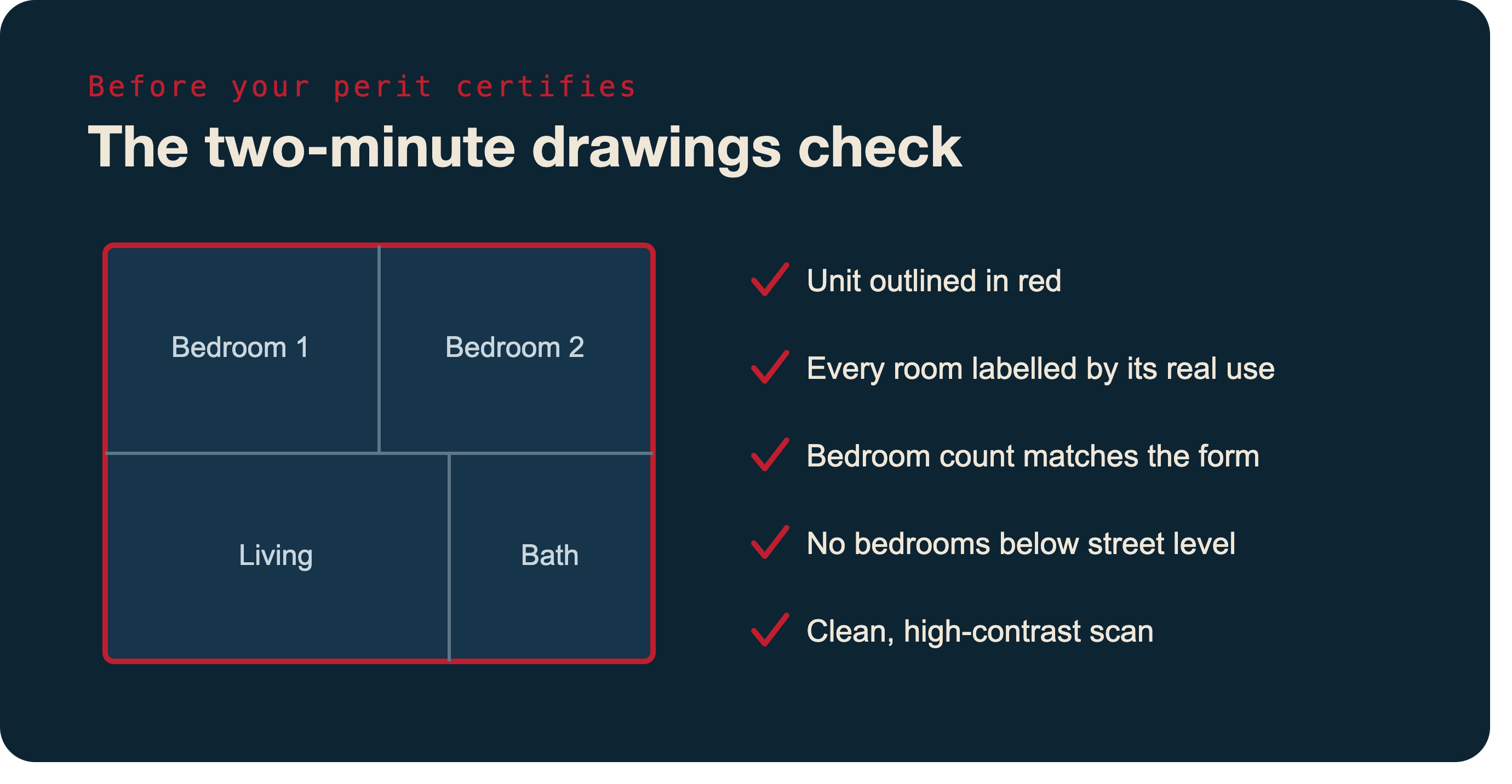
Here's the one that stings, because it's so avoidable: a file that's hard to read, or that contradicts itself, gets bounced before anyone even weighs the merits. A grey phone-photo of a plan; a room your form calls a bedroom but the drawing labels a store — that's all it takes. Before your perit certifies and you submit, run this two-minute check on the drawings themselves:
- High contrast, clean scan — grey, dark or photographed pages are not reviewed. Black lines on white, straight orientation.
- Unit outlined in red, unambiguous even printed in black and white.
- Every room labelled with its actual declared use — a stray "wardrobe" or "store" label where your application says bedroom is enough to bounce a file.
- Bedroom count consistent everywhere — drawings, application form and listings must match; it drives your legal guest cap (2 per approved bedroom, 10 max per unit unless independent street access).
- No basement bedrooms — rooms below street level cannot be guest bedrooms under the 2026 rules.
While you wait: the two rules that kill applications
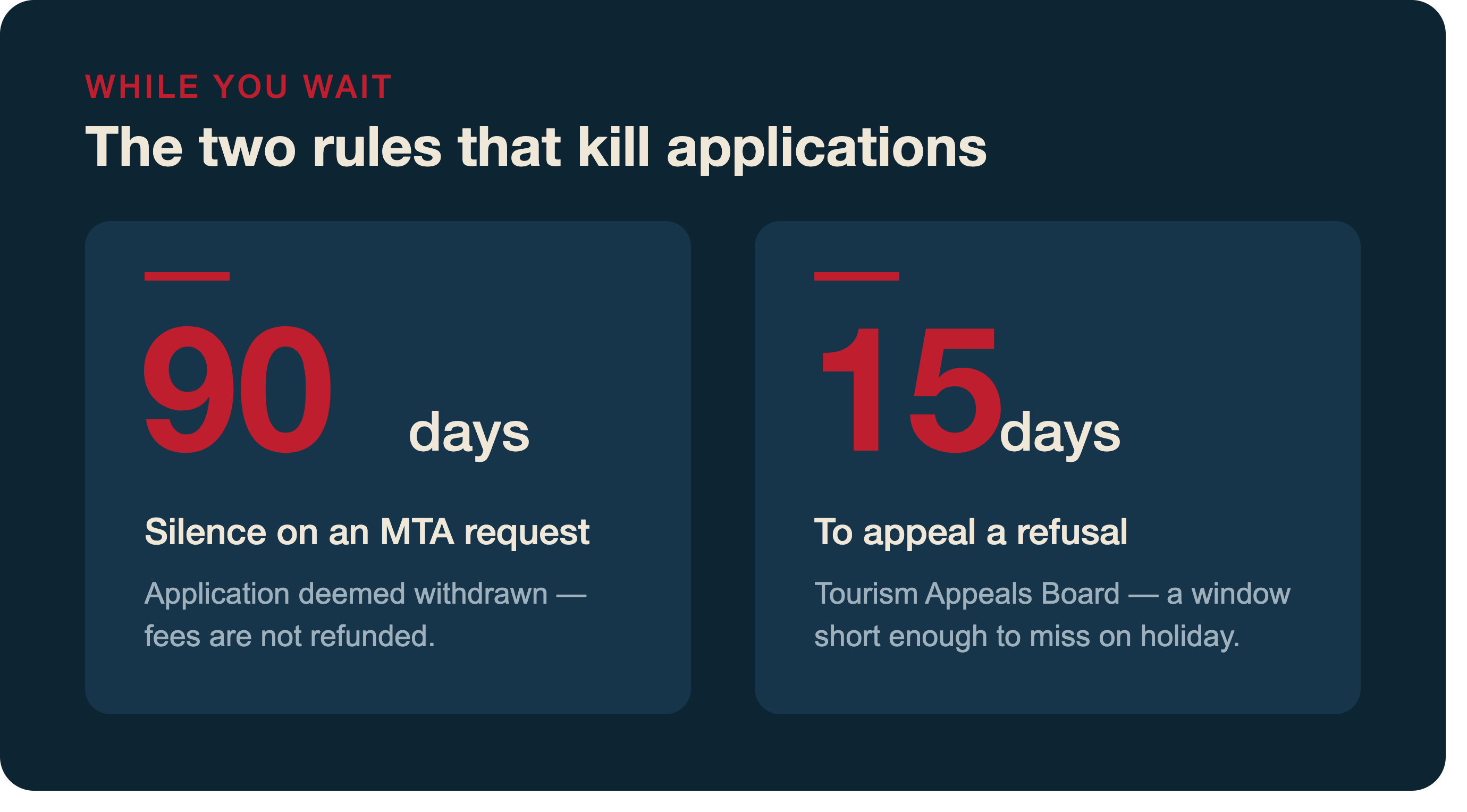
The 90-day silence rule: if the MTA asks you for anything and receives no response within 90 days, your application is deemed tacitly withdrawn — fees not refunded. Track every request and answer fast. The 15-day appeal window: a refusal (or any decision you contest) goes to the Tourism Appeals Board within 15 days — a window short enough to miss over a holiday. Put both on a calendar the day you submit.
And the rule before all rules: do not operate while unlicensed. The 3-year disqualification is the new regime's teeth, and it bites the property address as much as the operator.
Once you're in: what Monday's submission starts
Decision within 60 days of validation; then the ongoing regime begins — entrance sign with your licence number and 24/7 contact, EPC displayed inside, block administrator notified in writing (copy to the MTA) if you're in a condominium, waste plan maintained, unannounced inspections possible, fees due each 1 January (contribution −20% if paid within 3 months). And one more step that's new this summer: once licensed, retrieve your STR registration number via the MTA's STR Licence Validator — it's the separate identifier heading to every listing.
Submission channel: the MTA has been modernising its process during the freeze — we'll publish the exact channel and any procedural specifics the day applications reopen. Check back Monday, or track it in Lisenza and get alerted.
Walk into Monday with a complete file
Lisenza turns this checklist into a live one for your property: every document tracked in a vault, pre-filled templates (waste plan, block administrator letter), plain-English explanations with the exact legal references, and alerts before anything expires. Free during early access.
Start free — be ready by MondayFrequently asked questions
When exactly do applications reopen?
Monday 27 July 2026. Renewals and applications already in the pipeline continued to be processed during the freeze — this reopening concerns new applications.
Is the half-price rule really worth rushing for?
Licences issued after 1 July pay half the annual fee and contribution for that year (reg. 6, Fees Regulations). Since anyone licensed in this wave is issued after 1 July, the discount applies automatically — the rush is about the queue and the risk, not the discount itself. But yes: first wave = faster licence = discounted year = earlier peace of mind.
My property doesn't meet every standard yet — should I wait?
Check which standards actually apply to you first: minimum bedroom sizes only concern properties purchased after 15 June 2026, and air-conditioning becomes mandatory in April 2028. Most other Sixth Schedule requirements (safety kit, bathroom ratios, equipment) are achievable in days, not months — audit your property against the applicable list rather than the full text.
I rent the apartment I want to license — can I apply?
Yes — lessees qualify as "proprietor in title" and can hold the licence, with the owner's written consent in the file. Full details in our application guide.
This guide is provided for general information by Lisenza, an independent product not affiliated with or endorsed by the Malta Tourism Authority. It is not legal advice. Based on S.L. 409.24, S.L. 409.05, Regulation (EU) 2024/1028 and operator-reported practice as at 22 July 2026 — procedures may be updated at reopening; always refer to official MTA guidance.